The Great Flood
2348 BC
📖 About This Event
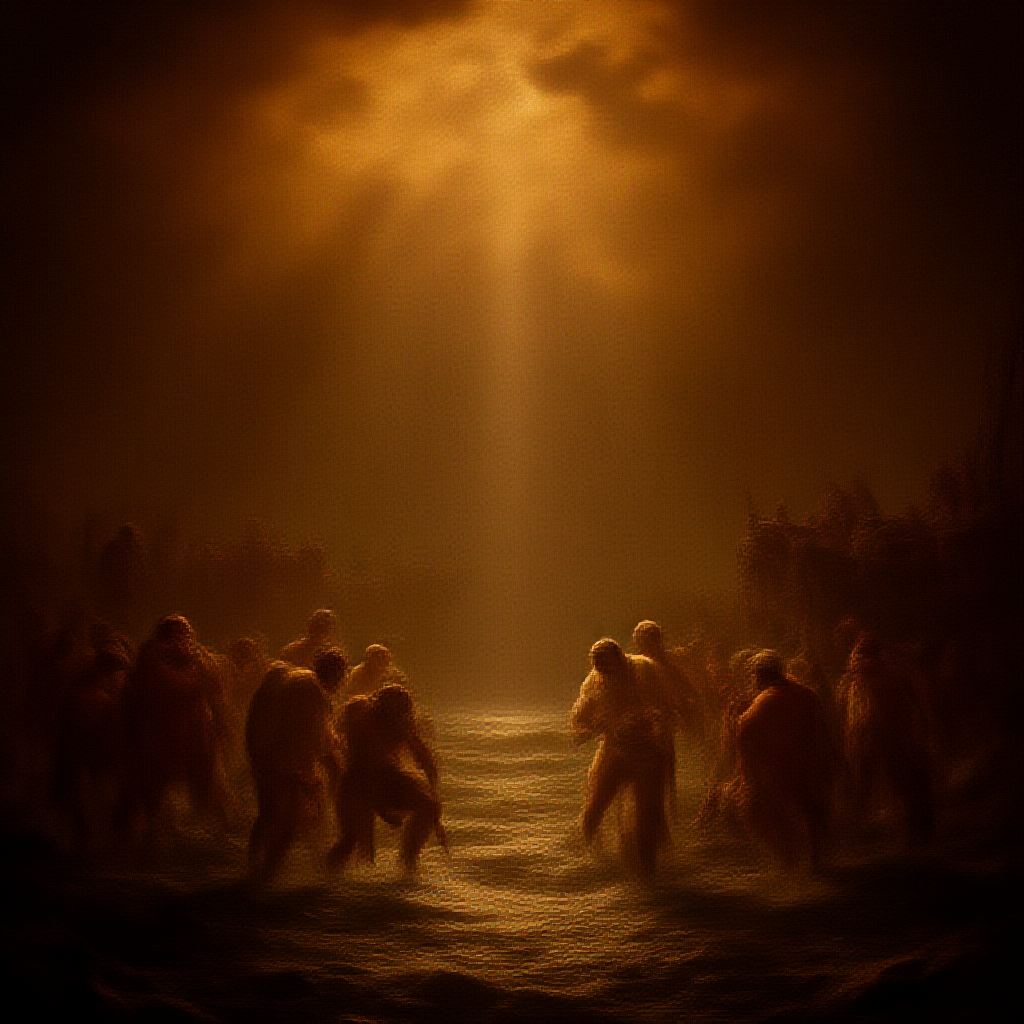
The Great Flood is one of the most dramatic events in sacred history, recorded in Genesis 6-9. In a world corrupted by widespread violence and wickedness, God resolved to cleanse the earth with a catastrophic flood. Yet He chose Noah—a righteous man who walked with God—to preserve a remnant. God instructed Noah to build an ark of gopher wood, specifying exact dimensions (300 cubits long, 50 cubits wide, 30 cubits high), and to bring his family (eight persons total) and pairs of every living creature into it. For forty days and forty nights, rain fell upon the earth, and the waters prevailed, covering even the highest mountains.
The Flood stands as a powerful type of baptism. St. Peter explicitly makes this connection: 'Baptism, which corresponds to this, now saves you, not as a removal of dirt from the body but as an appeal to God for a good conscience, through the resurrection of Jesus Christ' (1 Peter 3:21). Just as the waters of the Flood destroyed the old corrupt world while preserving Noah and his family in the ark, so baptism washes away sin and brings the believer into new life in Christ. The Flood also demonstrates God's dual nature as both Judge and Savior—He judges sin with terrible severity, yet in His mercy He always preserves a faithful remnant.
After the waters receded, God established a covenant with Noah and all living creatures, setting the rainbow in the clouds as a perpetual sign: 'Never again will there be a flood to destroy the earth' (Genesis 9:11). This unconditional covenant demonstrates God's commitment to sustain creation despite human sinfulness. Key Scripture: Genesis 6-9; 1 Peter 3:20-21; Hebrews 11:7; Matthew 24:37-39; CCC 600-601