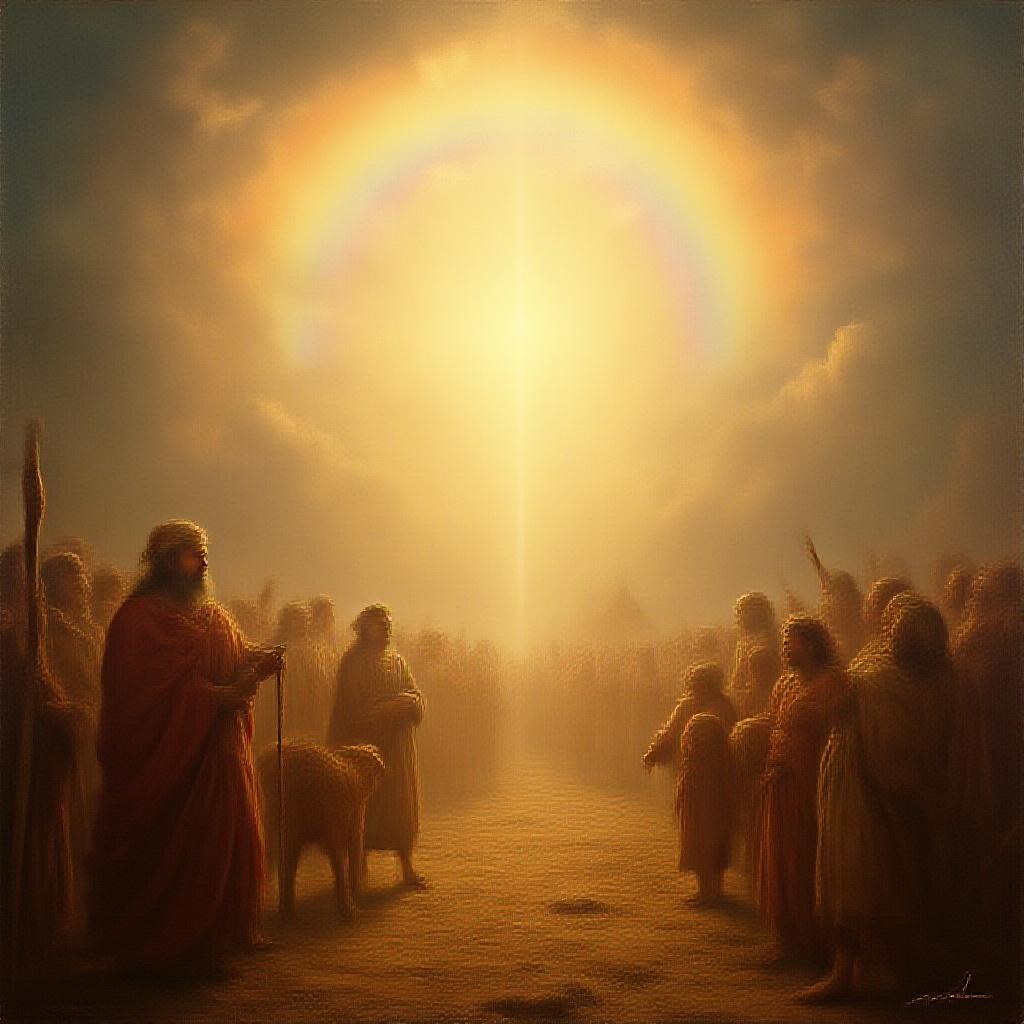
God's Covenant with Noah
2348 BC
📖 About This Event
God's covenant with Noah (Genesis 6-9) is one of the most significant covenants in the Old Testament. Seeing the wickedness of humanity, God decided to send a flood to destroy the earth, but Noah 'found favor in the eyes of the Lord' because he was 'a righteous man, blameless in his generation; Noah walked with God' (Genesis 6:9). God instructed Noah to build an ark—300 cubits long, 50 cubits wide, and 30 cubits high—to save his family and pairs of every living creature.
The flood came as God had promised, and only Noah, his wife, his three sons (Shem, Ham, and Japheth), and their wives survived. After the waters receded, Noah built an altar and offered burnt offerings to God. God then established His covenant with Noah and all living creatures: 'Never again will I destroy all living creatures because of man, for the inclination of man's heart is evil from his youth' (Genesis 8:21). As a sign of this covenant, God set His rainbow in the clouds.
The Catholic Church sees Noah's ark as a type of the Church and of baptism. St. Peter writes: 'Baptism, which corresponds to this, now saves you, not as a removal of dirt from the body but as an appeal to God for a good conscience, through the resurrection of Jesus Christ' (1 Peter 3:21). Key Scripture: Genesis 6-9; Matthew 24:37-39; Hebrews 11:7; 1 Peter 3:20-21; CCC 60, 1218